The coast gives Myrtle Beach its charm, but it also puts every roof on a tougher schedule. Salt air rides in on sea breezes, humidity lingers late into the evening, and summer storms punish whatever is loose or weak. If you own a home in Carolina Forest, Surfside, North Myrtle, or down in Murrells Inlet, you have seen those black streaks creep down asphalt shingles and the pale freckles of lichen settle in around roof vents. That is not just cosmetic. Left alone, it becomes a moisture trap that shortens Roof Washing roof life and raises the odds of leaks right when hurricane season puts your home to the test.
This is where thoughtful Roof Cleaning, done with the right methods for our climate, pays for itself. Roof Washing in Myrtle Beach is not a luxury. It is a practical step to stop damage, keep insurance and warranties on your side, and buy years of life for your shingles, metal panels, or tiles.
What those stains are really doing to your roof
Most black streaks on asphalt shingles come from a hardy algae called Gloeocapsa magma. It thrives in humid, warm places with plenty of shade, which makes north-facing slopes and sections tucked under oaks and pines prime real estate. The streaks are more than ugly. The algae forms a biofilm that holds moisture, and that moisture softens the edges of granules on shingles. Granules provide UV protection. Once they loosen and wash into your gutters, shingles age faster, curl sooner, and become brittle under heat.
Moss is rarer in our area than in the Pacific Northwest, but where sprinkler overspray or constant shade keeps shingles damp, moss shows up. It builds sponge-like mats that wick water backward under shingle tabs. In a decent downpour, that water can find nail holes and seams, then track into the deck and insulation.
Lichens are stubborn little organisms that anchor to the shingle surface like tiny suction cups. Their roots etch the asphalt binder, which makes power washing a terrible idea. Rip them off quickly and you pull away granules with them. The right way to handle lichen is patient chemical work.
On metal roofs, you see more salt film, pollen grime, and in spots where tree limbs rub, a bit of surface oxidation. Paint systems on metal panels do fine with careful Soft Wash Roof Cleaning and quick rinses, but long chemical soaks and high pressure can rough up a finish. Clay and concrete tiles grow algae like a canvas grows patina. The risk with tile is not the algae, it is stepping in the wrong place or flooding a low-slope section with too much water.
Why Myrtle Beach roofs need a different approach
I learned early that what worked for inland jobs falls short at the shore. In Socastee and Little River, roofs collect a chalky dusting from salt mist, then bake under UV all summer. Afternoon thundershowers pound during June and July, and tropical systems from August through October will find every weak spot. Those conditions shift the calculus:
- We clean more gently because shingles already run hotter and drier on the surface, which makes granules easier to dislodge with poor technique. We rinse more, especially around metal flashings, skylights, and solar hardware, because saltwater and chlorine should not sit on those surfaces. We suggest a slightly tighter maintenance cycle, often every 18 to 24 months, to prevent algae from reestablishing a foothold.
You also see different patterns by neighborhood. In Market Common with its maturing trees, shaded north slopes stain first. In open, newer sections of Carolina Forest, the wind drives salt and pollen across ridge vents and into the laps on metal panels. Down near Murrells Inlet, marsh breezes push moisture under the overhangs. Tailoring the cleaning plan to those small differences matters.
Soft Wash Roof Cleaning, not pressure blasting
I still meet homeowners who think Roof Washing means pressure washing. On siding or concrete, a controlled pressure wash has its place. On shingles and many tile roofs, it is the wrong tool. Most shingle manufacturers say so plainly, and some warranties can be voided by evidence of high pressure.
Soft wash is a method, not just a lower setting on a machine. It uses a dedicated pump to apply a cleaning blend at low pressure, roughly garden hose levels, then allows dwell time for the chemistry to work. The blend usually contains sodium hypochlorite in a controlled concentration, a surfactant to help it cling and penetrate, and water as the carrier. The algae dies, lichen loosens its grip, and stains lift without scrubbing or blasting. For asphalt shingles here, a working concentration on the roof surface in the 3 to 6 percent sodium hypochlorite range is typical, adjusted for stain severity and ambient temperature. On hot July afternoons, dwell times shorten because the mix dries faster. We work earlier in the day or in shaded sections to keep wet edges alive long enough to clean thoroughly.
Tile and painted metal can take lighter concentrations, with more attention to rinse water management. Copper, lead, and zinc surfaces like ridge caps or pipe boots deserve fast rinses, since hypochlorite will discolor them. Where cedar shakes or specialty materials appear, the plan changes entirely. Wood wants oxygen-based cleaners and a gentle hand to lift mildew without stripping natural oils.
The risks that come with the wrong cleaning
I have walked roofs where a previous crew used a turbo tip and left wand marks you could trace from the ladder. The shingles looked clean that day. A year later, the owner had bare asphalt flecked with granules in the gutters and early granule loss on the sunniest face. I have also seen landscapers try to “help” with a pressure washer and push water up under a ridge where the underlayment was nicked. A thunderstorm that night put a brown stain on the bonus room ceiling.
Even without pressure, mistakes happen. Leaving strong chemical on anodized aluminum or copper for long periods discolors it. Letting runoff soak a flower bed without pre-wetting and post-rinsing burns leaves. Anyone who has torched a stand of gardenias in July only needs to do it once to respect plant protection.
A careful Roof Cleaning plan uses controlled application, shields or rinses landscaping, and works top down so contaminated rinse water never flows uphill or underlaps. If a crew cannot explain how they proportion their mix, protect plants, and keep themselves tied off, keep looking.
How often to schedule Roof Cleaning in Myrtle Beach
There is no single calendar that fits every house. Here is the rule of thumb I use with clients from Surfside to North Myrtle: if you see black streaks, you waited six to twelve months too long. Better to clean when the first haze appears, then maintain on intervals based on shade and proximity to salt and trees. For most asphalt shingle roofs, every two years holds algae at bay and keeps granule wear slow. Shaded lots or homes near the marsh do better at every 18 months. Metal roofs can often stretch to every three years, provided the finish is rinsed periodically and tree debris is cleared.
Remember the local rhythm. Spring is a smart time to schedule because you clean off winter pollen and mildew before summer heat bakes stains in. Fall also works well, particularly after the peak of hurricane season. I avoid peak afternoon heat when the mix evaporates too fast and can spot plants more readily.
Quick signs your roof needs attention
- Black streaks or patchy dark areas that do not rinse off with rain Moss or lichen colonies around vents, in valleys, or on north-facing slopes Grit in the gutters, especially after a storm, which hints at granule loss Rust trails or chalky residue on metal panels near laps and fasteners Musty odor in the attic after rain, suggesting moisture is migrating
Cost, time, and what to expect on cleaning day
Most homes I see in the Myrtle Beach area fall between 1,600 and 3,000 square feet of roof surface, depending on pitch and overhangs. A straightforward Soft Wash Roof Cleaning job typically lands in the 300 to 900 dollar range, or about 20 to 50 cents per square foot, with steeper, complex roofs coming in higher because of extra time and safety rigging. If heavy lichen requires multiple applications weeks apart, that adds labor but usually still costs far less than a repair from a slow leak.
The work itself often takes two to four hours for an average roof, longer when we need to manage delicate landscaping or stage work around active solar arrays. Expect hoses, a quiet 12-volt or gas-assist pump, and a soft-stream rinse. You should also expect plant protection. On a job off Highway 90 last summer, the homeowner had prize azaleas along the front walk. We pre-wet them, laid breathable tarps, and kept a rinse tech in the yard the whole time. Not a leaf burned, and the flowers popped a week later, happy as ever.
If you spot crews blasting high pressure from a ladder without stepping on the roof, be wary. Proper Roof Washing in Myrtle Beach requires eyes on fixtures, flashings, and seams, and usually at least some roof access with fall protection.
Preventing leaks is the priority
At its core, professional Roof Cleaning is leak prevention. Killing algae preserves granules and the waterproofing they provide. Softening and removing lichen avoids pulling off protective layers. Clearing debris from valleys and behind chimneys lets water run where it should. When you clean, you also see things you would miss from the driveway.
I keep a short photo log for every job. On a home in The Farm at Carolina Forest, we found a nail pop along a ridge line where the algae made the surface look uniform from the ground. Up close, the lifted shingle tab stood out. A dab of roof cement and a new nail kept water out during the next downpour. That small fix is not the roof cleaner’s legal role, but the set of eyes is part of the value. Flashings get a once-over. Exposed fasteners on metal get flagged. Sealant past its prime around a satellite mount is noted with a picture. This is how a 500 dollar maintenance visit can save a 1,500 dollar drywall and insulation repair.
DIY or hire a pro
I am honest with homeowners who like to do their own work. If you are comfortable on your roof, own proper footwear, and understand basic fall protection, you can buy a pump sprayer and a mild cleaner and knock out a light maintenance cleaning on a single-story ranch with a friendly pitch. Many folks prefer to stay off steep sections, let alone the slick granule surface after you pre-wet it. That is a wise boundary.
The chemistry also deserves respect. Store bleach blends safely. Mix in a ventilated area. Label containers so kids and pets never risk exposure. Advanced Power Wash soft wash Myrtle Beach Use a surfactant meant for roof work so runoff sheets without foaming into the neighbor’s yard. Keep a hose at the ready to rinse plants before, during, and after.
If you are shopping for a pro, ask a few grounded questions. What concentration will you apply to my roof material? How will you protect copper and aluminum fixtures? How do you manage runoff around foundation plantings? Do you carry fall protection and liability insurance specific to roof work? A good company answers crisply, not with buzzwords.
The soft wash process that works here
Every crew has a rhythm. Here is the sequence that has held up for me along the Grand Strand.
- Walk the property with the owner to mark plants, pet areas, and sensitive materials. Pre-wet landscaping and position tarps where needed. Disconnect or divert downspouts if they empty into delicate beds. Stage ladders and set roof anchors where pitch dictates. Wear non-marking, high-traction shoes. Mix the cleaning solution to suit stains and material. Pre-test an inconspicuous area. Apply from the ridge down in controlled sections. Avoid overspray on windows and neighbor yards. Allow dwell time, typically 10 to 20 minutes per section. Keep edges damp to prevent spotting. Rinse fixtures and metals promptly. Rinse plants again. On stubborn lichen, apply a second light coat and let weather break it down over days, rather than scraping. Final rinse where appropriate and walk the roof to check for missed shadows or problem spots. Photograph any maintenance issues to share with the owner.
That entire flow respects the roof’s job, which is to shed water cleanly and keep the structure dry. The cleaning never forces water uphill, underlaps, or into ridge vents.
Roof material specifics around Myrtle Beach
Asphalt shingles remain the norm here, and they respond best to Soft Wash Roof Cleaning. The binders that hold granules soften a bit during summer heat. That is not a problem until pressure scours at close range. Keep pressure low and the chemistry right, and shingles clean up quickly with their protective layer intact.
Metal roofs show up more often on porches, additions, and modern builds. Factory coatings vary, but most are fine with soft wash concentrations on the lower end and thorough rinses. Pay attention to fastener heads on exposed-fastener systems. If rubber washers are cracked, they will leak under a hard rain that follows cleaning. I document those and suggest a roofer replace them soon.
Clay and concrete tiles in our area are less common than in Florida, but they appear. The hazard is foot traffic and water volume. Walk on the crowns or designated step areas to avoid breakage. Use light pressure and chemistry, then rinse at low volume to avoid driving water beneath overlaps.
Flat roofs on coastal condos run TPO or modified bitumen. These are best left to pros with the right cleaners and low-pressure rinse wands. Strong oxidizers and pressure risk seam failure or membrane chalking. If you manage a small flat roof, periodic rinses to move pollen and salt are often enough between professional maintenance cycles.
Cedar shakes, while rare here, deserve a special note. Skip hypochlorite and go with oxygenated cleaners that lift mildew without stripping natural oils. Plan a gentle rinse and time to dry thoroughly.
A word on warranties and insurance
Manufacturers include cleaning guidance in their technical literature. Most caution against high pressure and abrasive brushing. Some explicitly endorse soft washing with hypochlorite at controlled concentrations. That is not legal fine print worth ignoring. If a storm later peels shingles and an adjuster sees wand marks or missing granules in streaks, the debate about pre-existing damage gets noisy.
Insurance companies like maintenance. They do not like preventable damage. A receipt and photo set from a reputable Roof Cleaning Myrtle Beach company helps your case if wind-driven rain exploits a vulnerability you could not see. Keep records. If you choose DIY, keep notes and simple before-and-after pictures.
Plant and property protection, the right way
I have met people who say they do not want chemicals near their camellias. I get it. I garden too. The truth is, sodium hypochlorite breaks down quickly when it meets organic materials and sunlight, but in the moment, it can spot leaves and stress plants. Good practice protects life and property while still doing the job.
Pre-wet plants so leaves are saturated with clean water first. Water the soil so roots are not thirsty. Use breathable tarps to block direct contact where spray drift is likely. Assign a rinse tech to stay on the ground and move with the applicator. Rinse metals and glass quickly to prevent etching. Divert downspouts if they empty into koi ponds or vegetable beds, then flush those areas thoroughly at the end. Keep pets and children inside until everything is dry.
If accidental spotting happens, do not panic. Rinse thoroughly and give the plant a day. Most bounce back. The best cure remains prevention through planning.
Preparing your home for Roof Washing Myrtle Beach
- Unlock gates and secure pets indoors for the day Move vehicles out of the driveway to give hose and ladder access Close windows, and check that attic fans and vents are operating Mark or point out delicate plants so the crew gives them extra care Share any known leaks or past repairs so those areas get special attention
That ten minutes of prep smooths the job and avoids surprises.
Aftercare and keeping the roof clean longer
Soft wash results do not fade a week later. Once algae dies, the roof sheds it, and the surfactant helps the wash move off cleanly. Any lichen left will bleach and detach over time with sun and rain. To keep results longer, trim back overhanging limbs to open the roof to more sun and wind. Check gutters twice a year so water leaves the roof quickly. If you have a shady, persistently damp section, a zinc or copper strip near the ridge can help. As rainwater washes over the strip, small amounts of metal ions discourage algae growth below. It is not a cure-all, but it lengthens the clean cycle.
For metal roofs, a gentle rinse with a garden hose every few months knocks down salt and pollen, especially on windward faces. That small habit protects the finish and keeps the roof looking sharp between professional visits.
Real results, close to home
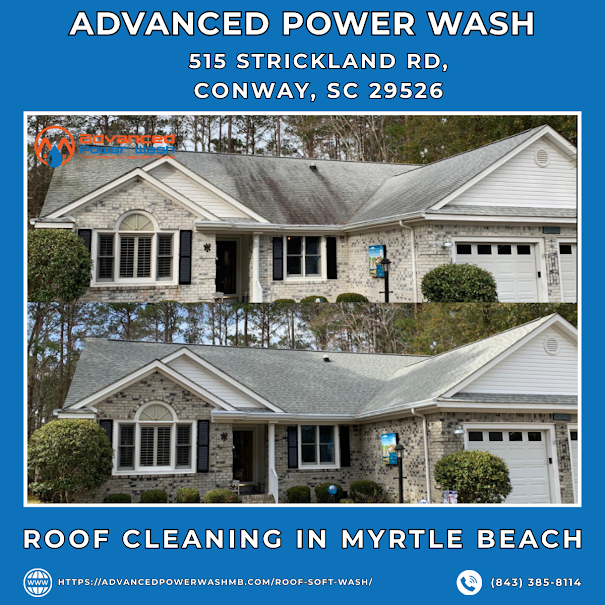
A recent job in a North Myrtle Beach neighborhood had a mix of challenges. The front elevation faced north under two tall pines. Black streaks poured down from the ridge, and lichen rings dotted the valley. The owner also had a copper bay window and a bed of gardenias right under the eave. We walked the site together, agreed on extra rinse care for the copper and plants, and planned a two-pass approach for the lichen.
We applied a mid-strength mix on a cool morning and kept the copper washed down as we worked. The algae dissolved within minutes, and the streaks lightened to a mottled gray. We left the lichen alone after a second light application and let time do the lifting. Three weeks later, I stopped by to check, and the lichen had flaked away, leaving intact granules beneath. The gardenias looked perfect, and the copper glowed without stains. The owner decided to add a ridge zinc strip on the worst slope to help keep the next cycle lighter. That is Roof Cleaning Myrtle Beach done with a little patience and a lot of care.
The bottom line for coastal homeowners
A clean roof lasts longer and leaks less. The Myrtle Beach climate rewards people who stay ahead of algae and grime. Choose methods that respect your roof’s materials, and the roof pays you back with quiet, leak-free seasons through summer storms and salt-heavy air. If you are on the fence, walk out to the curb and study your ridgeline. If you see dark bands or feel grit where downspouts exit after a rain, it is time to act. Find a pro who speaks fluently about Soft Wash Roof Cleaning, or go slow and careful if you prefer DIY.
Either way, protect landscaping, use chemistry wisely, and take the opportunity to scan for small issues while the roof is easy to read. Do that every year or two, and you keep control of maintenance instead of letting the climate pick the timing. Roof Cleaning and smart Roof Washing practices in Myrtle Beach are not about curb appeal alone. They are a simple, proven defense against leaks and damage when the coast throws its worst at your home.